Offseason Optimism: Penn State receivers set up for better success in 2024
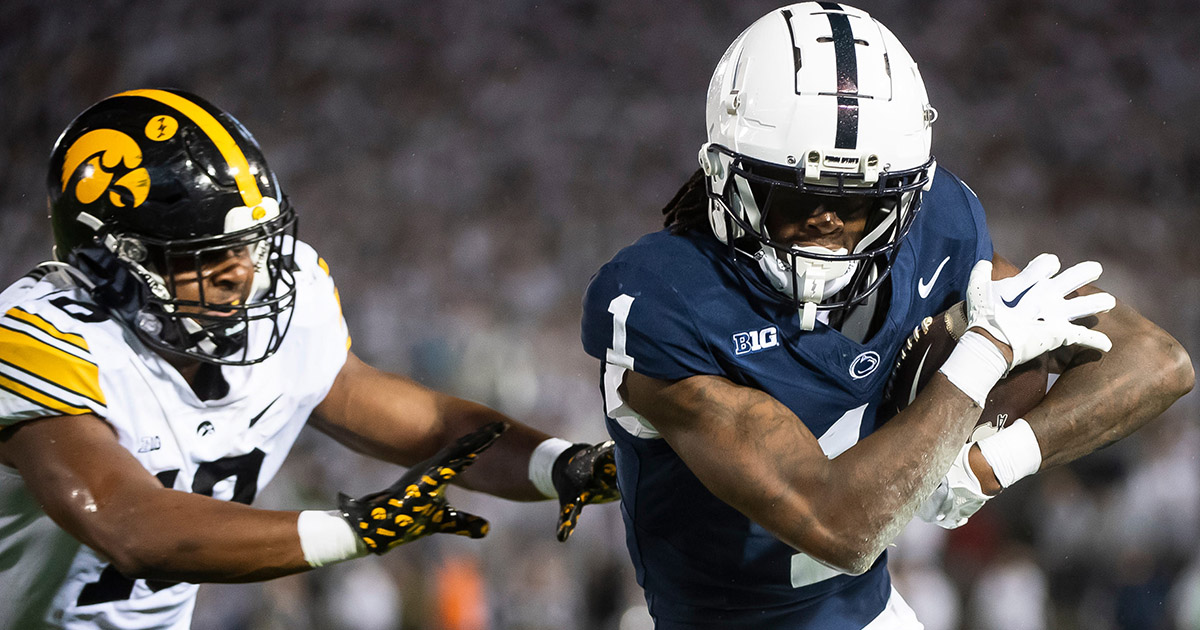
The winter months can be a long and lonely time for college football fans, especially if their team ends the year with a loss. That is the case this year for Penn State football fans who saw the Nittany Lions fall in the Peach Bowl last December. That’s why we’re trying to lift spirits in February with one aspect of each position group on offense that was a strength last season. We’re selecting things from advanced data that tell a positive story and one that can translate to 2024. Today, we’re reviewing the Penn State wide receiver room.
Yet this analysis is more complex than the previous examinations of the offense. There were significant disruptions at the position due to injury. Despite the opportunity, no significant data points stand out for this group. So, instead, we’ll be looking at the situation heading into 2024 from a more schematic standpoint.
Scheme was a significant issue for Penn State receivers
Today, we’ll be focusing on starting receiver KeAndre Lambert-Smith for several reasons. First, he was the team’s top target in 2023. Secondly, he was the only receiver with consistent production through most of the season. Lambert-Smith saw 85 targets on the season, more than double the next closest wide receiver. That player, Dante Cephas, saw two or fewer targets in six of the first seven games.
This season, Penn State’s receiving room already feels more stable with the addition of Julian Fleming. Not only is Fleming a veteran, but he’s also a proven product on the Big Ten level and comes to Penn State with a known work ethic and a solid set of skills.
Fleming saw at least three targets in nine games last season. In 2022, Fleming saw that number of targets in every game. While we have yet to determine what is in store for 2024, the team should have a better threat balance just with Fleming on the field.
Target value
Possibly, the biggest issue was that Lambert-Smith was filling multiple roles for the team. He led the unit with 14 deep targets, and no other player had more than four (Cephas). The Penn State receiver saw most of his targets (50) under ten yards. In fact, that was a common theme for the offense and its struggles.
Last season, 54.7% of the team’s passing targets to receivers were ten yards or under. The team already had a heavy run team that targeted the tight ends. By comparison, Kansas had a much more open and aggressive passing attack. New offensive coordinator Andy Kotelnicki found a way to get the receivers the ball downfield into the medium and deep areas more often. Only 37.6% of Kansas’ wide receiver targets were under ten yards. Kotelnicki achieved this despite playing three quarterbacks and having triple-option elements to the team’s offense.
Penn State’s current receivers have the speed and athleticism to make big plays. The key is getting them more valuable targets by opening up more first-read options for the quarterback downfield. Lambert-Smith was effective in these areas last season. According to PFF, he caught 11 passes for 227 yards on throws 10-19 yards downfield. Those 227 yards were 11th among Big Ten wide receivers last season.
Big plays more often
Certainly, variables outside of the receiver skill play into this next part, but Kansas did an excellent job with the deep ball last season. Big 12 defenses are different than Big Ten units, but the efficiency for Kansas was impressive last season. If you stack the Kansas receivers up against Penn State’s, the Jayhawks take four of the top five spots for deep receiving yards.
Does the quarterback play into this? Yes. But that doesn’t explain the massive gulf in efficiency between the two teams.
Cohesive offensive fit better for Penn State
Let’s circle back to Fleming and Lambert-Smith to end our discussion about the receivers. These two are the only proven players with enough targets and data to make reasonable judgments. Last season, Lambert-Smith had to be the team’s primary slot and Z receiver. It’s a reasonable assumption that Fleming can take the burden of playing outside for most of the team’s snaps off Lambert-Smith’s plate.
Once again, Kotelnicki found a way to be more explosive out of the slot at Kansas. The team gained 961 yards throwing to slot receivers compared to Penn State’s 536. More importantly, they did so on virtually the same number of targets. Kansas quarterbacks targeted slot receivers 14.8 yards downfield in 2023, compared to a paltry 9.0 for Penn State. Lambert-Smith is an explosive athlete and can stretch defenses with speed and elusiveness. Not only can he play more snaps in the slot next season, but he can be more effective if Kotelnicki can replicate his success in 2024.
From a schematic to personnel standpoint, Penn State is in a much better position heading into 2024 than last year.
The post Offseason Optimism: Penn State receivers set up for better success in 2024 appeared first on On3.