How does Texas profile for the playoffs?
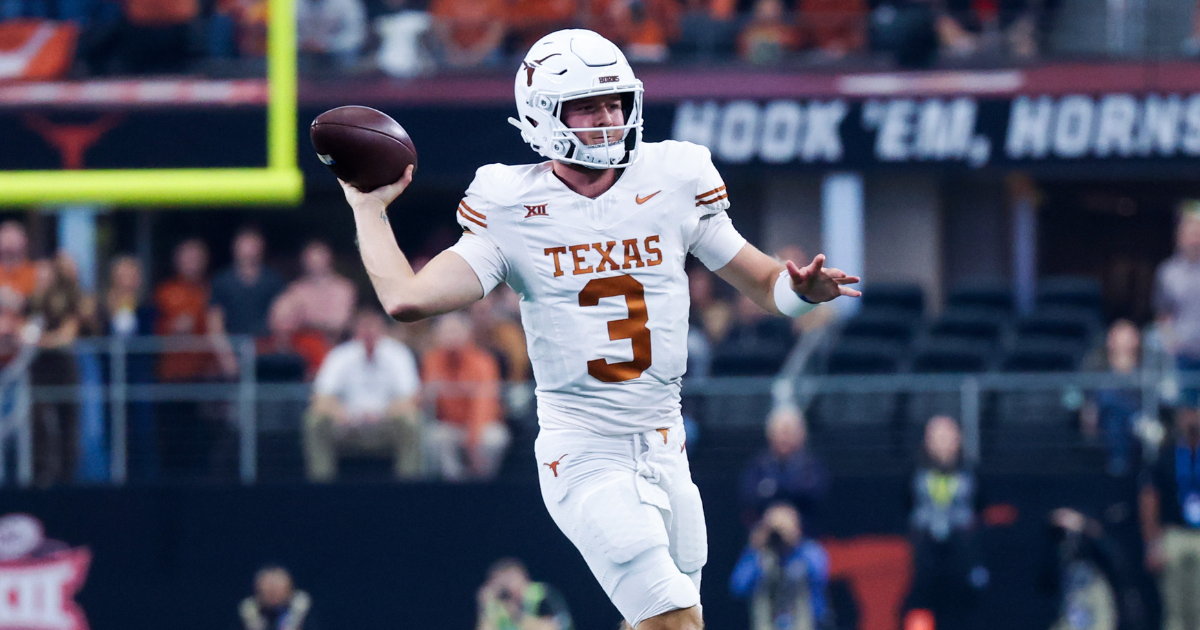
We already covered the 1-seed Wolverines and 2-seed Huskies, next up is (checks notes) ah yes.
I did warn everyone. From my preseason series on playoff contenders:
I know, I know. For Texas to simply win the Big 12 would be an exciting turnaround for a program who’s wandered in the wilderness for over a decade now since Colt McCoy went down against Alabama in the 2010 Rose Bowl.
They’re also coming off an 8-5 season, so it’s not like they’re already proven what they’ve got and are now building onto the next thing. No one wants to pick Texas to make the playoffs, including me.
But college football doesn’t work in a clear, linear fashion. There used to be a term called “Clemsoning,” where a team with promise would find a way to blow it. Then Clemson won two National Championships. Bob Stoops and Kirby Smart both played for championships in their second years on the job and neither were great in their first. Things can change quickly.
And concluding with…
All of the pieces and tactics are there and there’s better depth behind them than has been normal in Austin. Is the roster, top to bottom, as big and talented as at Alabama or Georgia? Nope, not quite. But the players at the most important positions are not only good but in many cases potentially elite.
Sure enough, Texas’ defensive tackle T’Vondre Sweat ended up winning the Outland Trophy, his partner Byron Murphy was 1st team All-Big 12, and both of Texas’ outside receivers are expected to be drafted.
The Longhorns fit the bill for a National contender and are even favored over the Washington Huskies, opening -4 and currently at -4.5 after an initial pro-Husky swing.
How did this happen?
The Texas Longhorns’ path to the playoffs
Texas didn’t draw too tough a schedule with just a few notable exceptions which made for some challenge. The Big 12 expanded early to add BYU, UCF, Cincinnati, and Houston, all of whom made for cannon fodder for the old Big 12. Texas got BYU at home and Houston on the road, along with a selection of traditional Big 12 teams in a down year for the league. Here’s where things were a little tough.
First, they had to travel to Alabama in Week 2 and play fellow playoff contestants on the road in a context where Nick Saban had not lost in a very, very long time. Texas won, thanks to coming out firing with the passing game and turning over Jalen Milroe early and often.
Next they caught Oklahoma after a remarkably easy slate for the Sooners which had clearly allowed them to get in tons of Texas prep. Oklahoma was all over Texas’ tendencies and their linebackers played their best game of the season. Ultimately the Longhorns were done in by Dillon Gabriel’s scrambling, which produced over 100 rushing yards and was instrumental on a final scoring drive for the Sooners which secured a late Oklahoma victory.
The team had to get through a 2.5 game stretch with back-up quarterback Maalik Murphy at the helm after Quinn Ewers suffered a separated shoulder for the second consecutive season. Amongst those was a home game against Kansas State which went into overtime and was won thanks in part to Chris Klieman going for it on 4th-and-goal from the five and getting stuffed.
Finally, the Longhorns managed to draw seven of the ir8te squads within the league, all of whom were eager to send Texas out with an L and eternal scoreboard. None of them managed it and Texas ended the year with Ewers back in the fold by administering the following defeats:
at TCU: 29-26at Iowa State: 26-16Texas Tech: 57-7Ok State (Big 12 CCG): 49-21
The name of the game for the Longhorns this season has been to count on elite defense, anchored by those dominant defensive tackles, while absolutely carving opponents to pieces in big games where Steve Sarkisian would always dial up some extra shot plays.
Quarterback Quinn Ewers is a primary-read, shot passing sort of guy with major limitations when the read is muddied or he has pressure, but Texas protected him very well and the primary read was often open. When his guy was open, he showed off one of the better arms in college football, particularly on intermediate routes.
Here were his lines in Texas’ three biggest games of the season:
Alabama: 24-38, 349 yards, 9.2 ypa, three touchdowns, zero picks.Oklahoma: 31-37, 346 yards, 9.4 ypa, one touchdown, two picks, one fumble.Oklahoma State: 35-46, 452 yards, 9.8 ypa, four touchdowns, one pick.
He diced each of them up, but against Oklahoma was done in by three turnovers. This offense, when they had teams calibrated carefully, could be pretty overwhelming. Otherwise they trusted in defense, special teams, and the run game. They could have all four factors going in the playoffs, depending on the extent to which opponents have to underplay the run game.
The Texas space force and planets
We have to start with Texas’ planet, T’Vondre Sweat, seen below after catching a wide open touchdown pass while serving as a tight end in a goal line, jumbo package.
As you can see, the Outland winner is a massive person. 6-foot-4, 362 pounds. The Longhorns use him as a 3-technique where he can two-gap a guard (usually shoving them sideways into the next man) while teammate Byron Murphy (6-foot-1, 310 pounds) played a more aggressive, upfield technique in the A-gap.
Murphy had 26 tackles, eight tackles for loss, and five sacks. Sweat managed 42 tackles, eight tackles for loss, two sacks, and also four pass break-ups. Their greatest impact was in allowing Texas to play base two-high defense and be lead in tackles by the inside linebackers.
It’s the same style Michigan plays but the Wolverines are more advanced with their zone blitz schemes.
In terms of the space force, the Edges are good not great. Texas employs a 2-4-5 as Michigan and Washington do and, like those programs, the Edges don’t have just amazing numbers. The two main starters are Barryn Sorrell and Ethan Burke, both of whom are in the 6-foot-4, 260 pound range (Burke is 6-foot-6) with good length and play strength. They’re both good at keeping runs boxed inside for the tackles and linebackers, they’re also good at applying consistent pressure but neither tends to overwhelm anyone truly good off the edge.
Cornerback is an area of interest. One of their starters is 6-foot-3 Ryan Watts, an Ohio State transfer who’s held down boundary cornerback the last two seasons. Watts doesn’t have ideal recovery speed but has seldom been beat in two years. The problem is that he’s fighting a hamstring injury which appears to be good now but, hamstrings being what they are you can never tell. Opposite is former 5-star Terrance Brooks, another big kid (6-foot-0, 6-foot-8 wingspan, 200 pounds). When Watts was out the Longhorns plugged in another blue chip in Malik Muhammad (Jabbar’s young cousin). Muhammad is the fastest of the trio but only a true freshman, about 181 pounds, and not always timely or forceful in the run game.
The Texas Star (nickel) Jahdae Barron is actually the best defensive back on the team and would be the best cornerback if he played outside. They have depth of quality in coverage but there’s no Derek Stingley here, not yet at least.
The offensive space force is better. Left tackle Kelvin Banks will likely be a first round pick in 2025 when he’s eligible for the draft and his counterpart Christian Jones is a likely late round pick in 2024. Banks is 6-foot-4, (long arms) 324 pounds and Jones 6-foot-6, 321 pounds. Between those two and Sark’s heavy use of max protection play-action, Ewers routinely has a lot of time to find their outside receivers down the field.
That’s where things get difficult for opponents. On one perimeter is Xavier Worthy (969 receiving yards, five touchdowns), a pure burner, and the other features Adonai Mitchell (813 receiving yards, 10 touchdowns) the lanky former Georgia Bulldog who caught a touchdown pass in all four of the Dawgs’ last four playoff games.
Ewers’ arm can easily reach either down the field and the playbook includes a number of screens and play-action shots to tight end Ja’Tavion Sanders (former 5-star, likely 2024 early round draft pick) running into the flats or middle of the field.
In other words, they have NFL tackles (on both sides of the ball), NFL wideouts outside, and some game-changing talents inside to boot at tight end and nickel. They’re a tough matchup.
Overall summary and prognosis
Texas is basically Ryan Day’s Ohio State with two major distinctions.
Ohio State has tended to prefer single-high coverage and aggressive, “gap out” play up front which allows the defensive tackles to get up the field. Texas plays “gap and a half” up front, emphasizing war-daddy defensive tackles rather than lighter athletes and use the savings from their sacrificial techniques to stay two-high in coverage (as needed). Texas’ style is a better fit for the modern game.
The other distinction is Ohio State wants to be able to run the football on conservative pass defenses, but they ran mostly 11 personnel and had a flex tight end. Texas also has a mobile tight end who’s iffy in the blocking game (Sanders) but when they want to run the ball they’re built to do so from 12 personnel while adding a big physical blocker (Gunnar Helm “the Hammerhand”) to the mix.
In fact, they’ll even use offensive lineman Malik Agbo as a “jumbo” tight end and sometimes pair him with Helm to get extra beef and physicality on the field. Main running back Jonathon Brooks went over 1,000 yards in 11 games before injury and back-ups Cedric Baxter and Jaydon Blue combined on 185 carries to produce 934 yards at 5.0 ypc with six touchdowns. The team surprisingly didn’t miss a beat in the run game when Brooks went down.
If say, Michigan, were to play the Longhorns as small and backed off as they’ve tended to do against Ohio State in the last few years, the Texas run game would be a much bigger threat than Day has been able to muster up.
The Longhorn’s weaknesses were all evident in the Red River Shootout against Oklahoma. They struggled with the quarterback draw and scramble, which probably won’t matter unless they make the finals, and tempo offense could be effective in mitigating their dominance in the trenches. Sweat’s 362 pounds work against him at some point, even though Texas substitutes often and effectively along the D-line.
Texas’ offense routinely bogged down in the red zone due to a combination of lack of mauling play inside (has gotten better as the season progressed) and Ewers’ struggles to make progressions. Shot passing faces diminishing returns inside the 20. Oklahoma State’s gameplan was to drop a safety deep (like 20 yards off the ball at the snap) and force Texas to sustain drives and convert in the red zone. But Sark had a number of good red zone plays dialed up and the ‘Horns went 5-for-5 scoring when they crossed the 20. That was all she wrote in that game.
Teams have tended to employ the three-high “Flyover” defense against Texas and many have mixed in Tampa 2 coverage as a way to avoid getting torched on deep crossing patterns. The Tampa 2 puts a safety over either lethal wideout while putting someone in the deep middle against the crossing routes Ewers routinely hits. As you can surmise from their 12-1 record, it didn’t necessarily work, but that’s been a common approach for a reason.
The underlying reality is that defeating Texas will require confusing Ewers so he can’t get to his read and then bringing pressure. He has one of the worst sack rates in college football this season. You can’t really cover all of Texas’ weapons, you have to attack the head of the snake which is Ewers’ ability to execute the Sark shot plays.
That’s a tough assignment when they have a month to prepare, but that’s what it’ll take to beat the Longhorns.
A Texas title would essentially be a triumph of the two main strategies prevailing in the modern game. First, Vic Fangio-style defense where you look to shut down the run without overcommitting resources and secondly, shot-passing offense where the offensive coordinator (Sark) has a lot of direct command over the game. We’ll see if any of the preferred strategies from the other three teams can overcome that combination with a month to prepare.
This article was originally published on America’s War Game.
The post How does Texas profile for the playoffs? appeared first on On3.