Second (and third) chances give Purdue its best chance
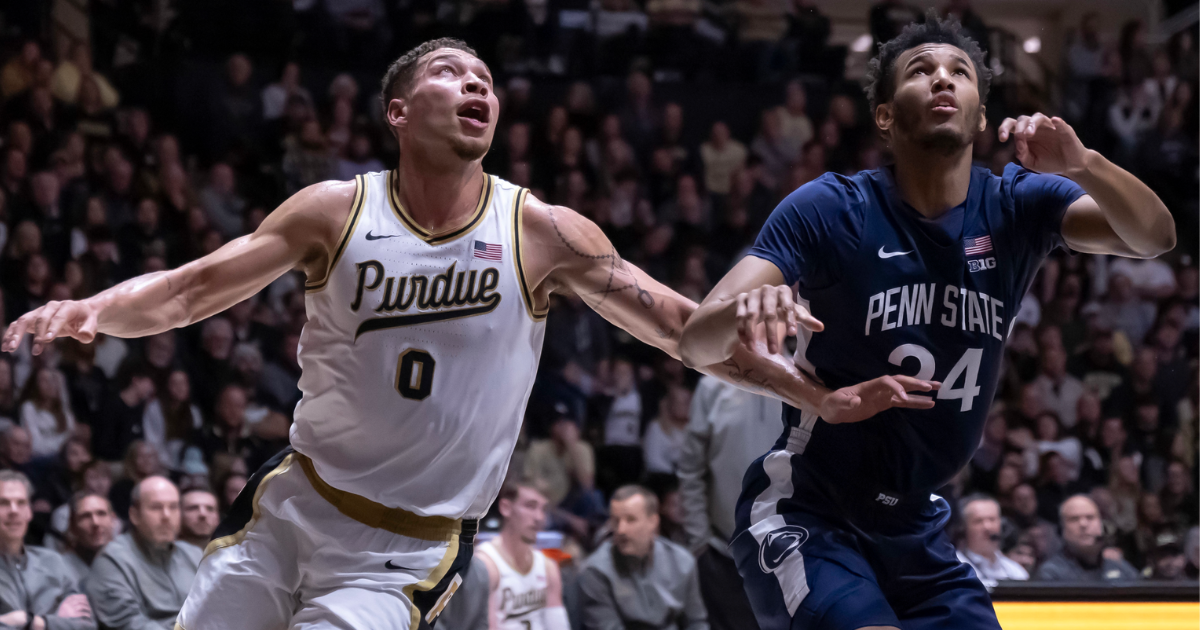
For as much as Purdue has become known for excellent offense driven by dominant big men and often high-end three-point shooting, there’s been a really important consistently tucked away in its winning calculus for many years now: Offensive rebounding.
Currently 17th nationally in offensive rebounding percentage, according to KenPom.com, Purdue is on pace for its sixth consecutive season in the top 20 in that category, peaking at No. 3 last season.
Purdue scored 21 second-chance points at Wisconsin Sunday, bring its season total to 308, an average of 13.4 per game. Essentially, second-chance points are the Boilermakers’ second-leading scorer.
This isn’t really new, though.
Coach Matt Painter had some great rebounding teams prior, but its consistency with offensive rebounding as culture really began in 2019, a season in which Purdue was carried by guard play and three-point shooting but also the basic arithmetic of possessions that’s become central to the program’s M.O.
The formula is to limit turnovers and gain possessions via second chances. It’s more complex than that and certainly easier said than done, but those elements when combined with highly efficient offense has been foundational to Purdue’s winning formula.
Turnovers are always a talking point for Painter and his staff, and their damage is probably more apparent to the casual observer than the benefits of offensive rebounding are, but the two do go hand in hand.
And while Purdue’s potency on the offensive glass has corollated closely with this run of elite big men Purdue has had come through the program, more has gone into it than just having big-time rebounders like Caleb Swanigan, Trevion Williams or Zach Edey or cold-blooded grinders like Grady Eifert and Mason Gillis.
UNRELENTING EFFORT AND PHYSICALITY
Zach Edey made the free throw, the one that made the score 19-12 in the first half, in Alabama’s favor, during the Boilermakers’ eventual win in Toronto earlier this season. Nevertheless, Mason Gillis wound up on the floor, on all fours, tripped by a Crimson Tide player who stuck his leg out instead of blocking out.
Countless moments every game, you can see such will from Purdue.
Dealing with Edey — probably the pre-eminent offensive rebounder in college basketball — is one thing for opponents, the indominatable presence on the glass that affects every play he is part of.
But it’s Gillis and Trey Kaufman-Renn who not only impact games as offensive rebounders but can always be seen rolling around on the floor or flying out of bounds chasing those second chances that have become an instrumental piece of the Boilermakers’ winning formula during this wildly successful modern-era run.
“Our playing styles are both very physical by nature. It just plays to our strengths,” Kaufman-Renn said.
Gillis and Kaufman-Renn have been real tone-setters attacking the offensive glass, shedding block-outs and using the gaps afforded by Edey’s blast radius, but Edey himself leads the charge, as his offensive rebounding percentage (No. 8 nationally) is the product of him going after every ball and rebounding outside his area unlike any player his size. Not that there are many.
And Edey’s offensive rebounding numbers aren’t even close to being the full story, because they don’t reflect the number of balls he’s kept alive, the number of fouls he’s drawn or the physical and psychological or strategic impact his presence may have on opponents around the basket.
But the most important part: Edey just plays hard. Size is important, but only part of the story of what’s made him the most impactful offensive rebounder in college basketball.
But it’s very important to note too that Gillis and Kaufman-Renn (and Caleb Furst) are real statement-makers when it comes to what sort of effort Purdue’s opponents will need to match on the glass.
SHOT TYPES
Purdue takes a lot of shots around the rim or from within the lane, the physics of which are more compatible with there being softer, more predictable rebounds. It’s an area where Purdue’s offensive focus on the paint trickles down.
“If we’re taking bad shots, it’s hard to get offensive rebounds, because our rebounders might not know that shot is going up and it might be so out of rhythm that we’re not in rebounding position,” Gillis said. “We do a good job running plays that make sure everyone’s in the right position and doing their specific jobs.”
Here’s an example of Gillis knowing exactly what’s about to happen.
This actually happens all the time, and Gillis almost assuredly is aware that no 4 man is going to think of blocking out 18 feet from the basket.
Purdue arguably has its best set of guards and wings in some time at getting to the rim, attacking closeouts and making runners. Those shots tend to yield higher-probability offensive rebounding opportunities, not only because of the angles, arc and such involved, but because the defense has been put on the move, compromising block-outs.
These Fletcher Loyer runners off closeouts are analytics darlings, because A) he can make them and B) if he doesn’t, this might be the most reboundable shot in basketball.
Purdue’s overall understanding of its offensive identity and machinations is a big deal.
“When you run plays and do stuff, you have to know where shots are coming from,” Painter said. “You’re running things for first, second and third options and with all those options, shots are coming from different places, but … also three different people. When they do, what are the other people doing?”
PLAY TYPES
A great example of the point above: Purdue is running more pick-and-roll than probably ever before for Braden Smith and Edey. This achieves the very important end of compromising the defense, getting guards downhill, but also unleashing a freight train down the lane and into prime offensive rebounding position.
Assume for a second this wasn’t a de facto pass by Smith. This is an unstoppable dynamic Purdue enjoys when rolling Edey to the rim.
PERSONNEL
Purdue playing huge in the frontcourt occupies a ton of space, and little crevasses for offensive rebounds to be mined from.
Sometimes blockouts just kind of take shape on their own, as Edey and Kaufman-Renn (6-foot-9, 240-ish pounds) flank one another on offense.
SCHEME
Purdue’s robust playbook has been crafted with offensive rebounding in mind, with a particular emphasis being placed now on involving all five players on the floor in, as opposed to having certain floor-spacers or screen-setters “float” away from the basket, according to P.J. Thompson, who’s calling Purdue’s offense and took the unit’s reins this past summer.
This is not new; it’s been a staple for as long as Purdue has faced post double-teams every single game. But when the center gets trapped, as Edey does more often than not, just like Isaac Haas and Williams and others like them did, the 4 man almost always cuts to the rim, fishing for a layup but also to establish rebounding leverage.
Additionally, each game brings different transition-defense concerns. If a team really wants to run (like Michigan State historically), then Purdue might send two men back as opposed to just the normal single safety. When opponents aren’t as transition-potent, Purdue might send an extra guard to the glass, on top of the extra body its defensive M.O. often already affords.
When a shot is taken, Purdue asks its primary on-ball defender — Lance Jones or Braden Smith this season — to move to the keyhole (the half circle) above the foul line. The intent: To position them in the middle of the floor to pick up/pressure the ball-handler once it’s thrown in.
This puts the Boilermaker guard centered on the floor, facing the basket and in prime offensive rebounding position. Depending on the player, they might have the leeway to try to go get the ball if the opportunity arises.
Great example …
Jones has been really effective in this role.
The post Second (and third) chances give Purdue its best chance appeared first on On3.